
Who Will Tatsuya Imai Be When He Comes to Major League Baseball?
A deep dive into the arsenal of Tatsuya Imai and how the Japanese star is going to translate in his first year pitching in MLB.
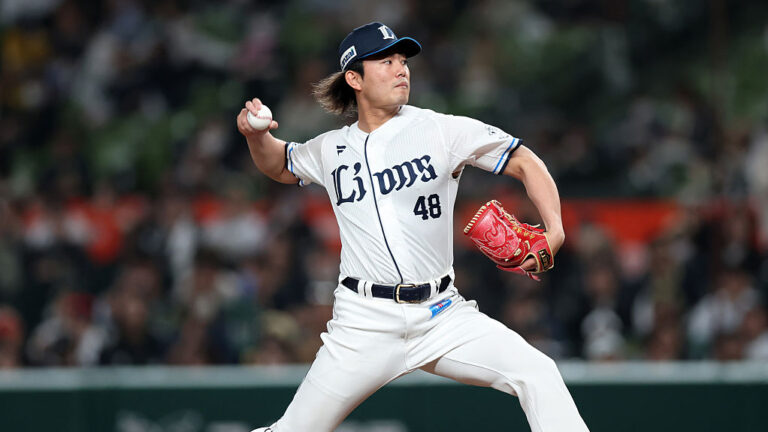
Japanese right-hander Tatsuya Imai may be one of the more unique pitchers I have ever looked into prior to their MLB debut.
From wide velocity fluctuations to a wrong-way slider and a unique arm angle, everything about Imai is unorthodox. He’s also coming off a season where he posted a walk rate nearly half of his career average.
Imai has already proven himself to be one of the best pitchers in NPB, but when it comes to offering him a long-term Major League contract that will surely exceed nine figures, there are two key questions that teams will need to answer internally.
Much like a big leaguer whose career year comes in his contract season, Imai provided his best showing in the season prior to being posted to be signed by MLB teams.
Not only will teams need to decide if the career-year and massive leap in command are replicable, but they will also need to decide how confident they are in his stuff playing in the big leagues.
Again, I have little doubt that Imai has what it takes to be a quality MLB arm, but that’s not the question. It’s a matter of how good, especially when the bidding could be anywhere from $100-170 million.
2025 Improvements
The 2025 campaign was a career year for Imai in just about every sense, as the 27-year-old pitched to a sub-2.00 ERA for the first time in his eight-year tenure with the Seibu Lions, with his 27.8% strikeout rate and 7% walk rate also career-best marks.
His more consistent results were in large part thanks to his improved fastball efficacy. Imai lowered his arm angle in 2025 from roughly 35 degrees to 28 degrees, helping the run and ride of the pitch play up while locating it more consistently.
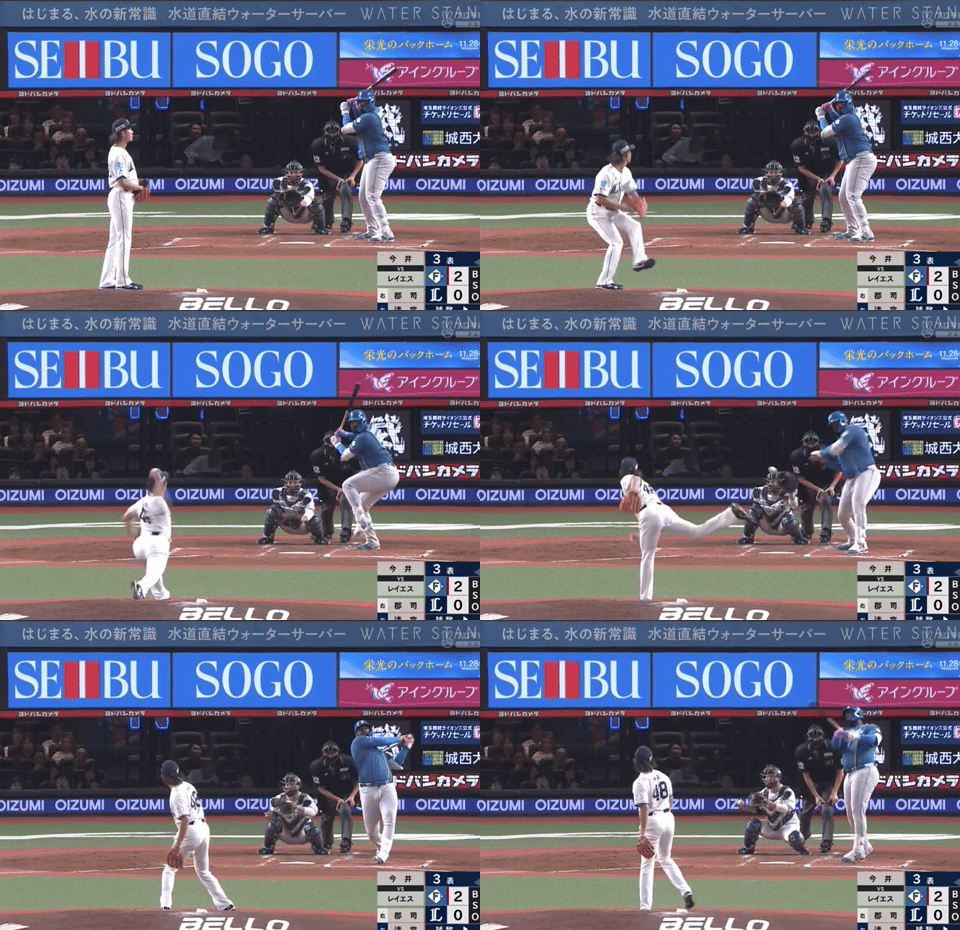
Imai’s strike rate jumped from roughly 62% in 2024 to 69% this past season, along with a swinging strike rate increase of 3% in ’24 to 10.5% in 2025. The pitch played better than ever in the upper half of the zone, and he leaned into it more, pitching in the top half 5% more frequently.
Of the 750 fastballs I was able to track in the upper half of the zone, Imai held opponents to a batting average of roughly .140, an OPS right around .440, and a chase rate north of 30%.
More on that in the next portion, but there’s reason to believe that even if he sheds some movement vertically and horizontally, the fastball can still be effective.
His secondaries were more effective as well, holding opponents to an OPS of roughly .440 in ’25 compared to .580 the year prior. With the gains between his fastball and secondaries, it’s not surprising that Imai yielded the lowest average exit velocity of his career at 83.4 MPH.
How Will it Translate?
In terms of arm angle and shape, Imai’s fastball most similarly resembles that of now-former Guardians arm Luis Ortiz and Seattle’s Luis Castillo — two heaters that have turned in good big league results despite not jumping off the page metrically.
There’s also a fair level of overlap with Joe Ryan’s fastball, giving up a little bit of carry in comparison, but providing more velocity.
His approach angle should be slightly flatter than both Castillo and Ortiz, which could result in even more success at the top portion of the zone, something that is combated with more success in NPB than MLB from a contact and chase perspective.
The average four-seam velocity from a five-foot slot or less was 93.3 MPH in 2025 with roughly 13 inches of induced vertical break. Accounting for the 1.5-2 inches of IVB he will likely lose with the MLB ball, Imai’s fastball shape should be roughly average for his release-height bucket at a higher velocity, but roughly two ticks harder on average with a potentially flatter approach angle.
Execution will be important though, and Imai can be inconsistent in that regard, even with his improved command in 2025. When Imai tugs the fastball towards the bottom part of the zone, it becomes more hittable as it seemingly stays on a more visible plane for the hitter.
It could benefit Imai to try to play around with a sinker to give him a ground ball pitch that could potentially dodge more damage while giving him a fastball he can trust at the bottom of the zone more. His pronation bias makes it the most realistic pitch for him to add, potentially creating a difficult tunnel for hitters off of the four-seam.
The sinker does not necessarily need to be as effective as his four-seamer, as he would likely use it less than the fastball anyway.
The blueprint to big league success for him points towards elevating the fastball more, making the sinker more of a pattern disrupter than a high usage pitch. As is the case with most NPB arms, Imai pitched to the top of the zone roughly 8% less frequently than the average MLB pitcher and projects to succeed in doing so more than the average MLB starter.
Another variable making Imai more difficult to assess is his wide range of fastball velocity that appears intentional. His average fastball velocity was 95 MPH last season, but it’s as wide a velocity distribution as you will see from a starter.
Being further incentivized to try to dial it up more while likely throwing 15-20 fewer pitches per outing than he is accustomed to could make it reasonable to project Imai averaging closer to 96 MPH stateside.
The “Wrong Way” Slider
Imai’s 85-88 MPH slider is his best swing and miss pitch, generating a swinging strike rate of 23% and chase rate north of 40% in 2025. It’s an incredibly rare shape, averaging 2.5 inches of break to the arm side and zero inches of vertical break.
There are almost no examples of sliders fitting a similar shape at the big league level over the last three seasons, but the two most similar sliders help Imai’s case with their results despite not being thrown by household names.
In fact, it was the most effective offering for Hans Crouse, Robert Stephenson, and Dauri Maureta.
| Player | Velo | V-Break | H-Break | SWSTR | Z-Whiff | Chase |
|---|---|---|---|---|---|---|
| Hans Crouse (2024) | 84 MPH | 1.1 in | 2.5 in | 22% | 25% | 35% |
| Robert Stephenson (2023) | 89 MPH | 1.6 in | 1.4 in | 34% | 38.6% | 50% |
| Dauri Maureta (2023/2025) | 84.4 MPH | 0.5 in | 7.1 in | 20% | 29.4% | 30.3% |
| Tatsuya Imai (2025 NPB) | 86.3 MPH | 0.1 in | 2.5 in | 23% | 25.4% | 40.5% |
With little precedent of Imai’s slider shape, any somewhat similar proof of concept is helpful in projecting how Imai’s slider will perform in MLB.
That said, his consistently high whiff and chase figures on the pitch in NPB bode well for his outlook, given the lower-whiff environment that Japan provides. While it is a completely different arm angle, the performance of Trey Yesavage’s arm-side slider in 2025 helps his case as well.
Even with the slider breaking arm side on average, Imai decimated right-handed hitters with the pitch, registering a swinging strike rate of 28.5%, an in-zone whiff rate north of 30% and an OPS against of roughly .450.

The pitch is still effective against lefties, but more as a get-ahead pitch, as it averages roughly a 10% lower swinging strike rate and zone whiff rate against lefties.
Imai’s two changeup variations will likely be key in putting opposite-handed hitters away stateside. His improved command and quality of both the fastball and slider help him get ahead of hitters of both handedness.
He will throw a changeup at 84-86 MPH and a splitter that is generally a tick slower. Both pitches missed barrels at a strong clip, but his command was far less consistent, posting a 56% strike rate compared to his combined 68% strike rate on the fastball and slider.
Imai throws the more traditional changeup more often (11% usage), featuring two more inches of horizontal and six more inches of vertical break from his splitter (7% usage).
It features more carry than most changeups from his arm angle, which could result in him leaning on the splitter more stateside unless he is able to find more depth.
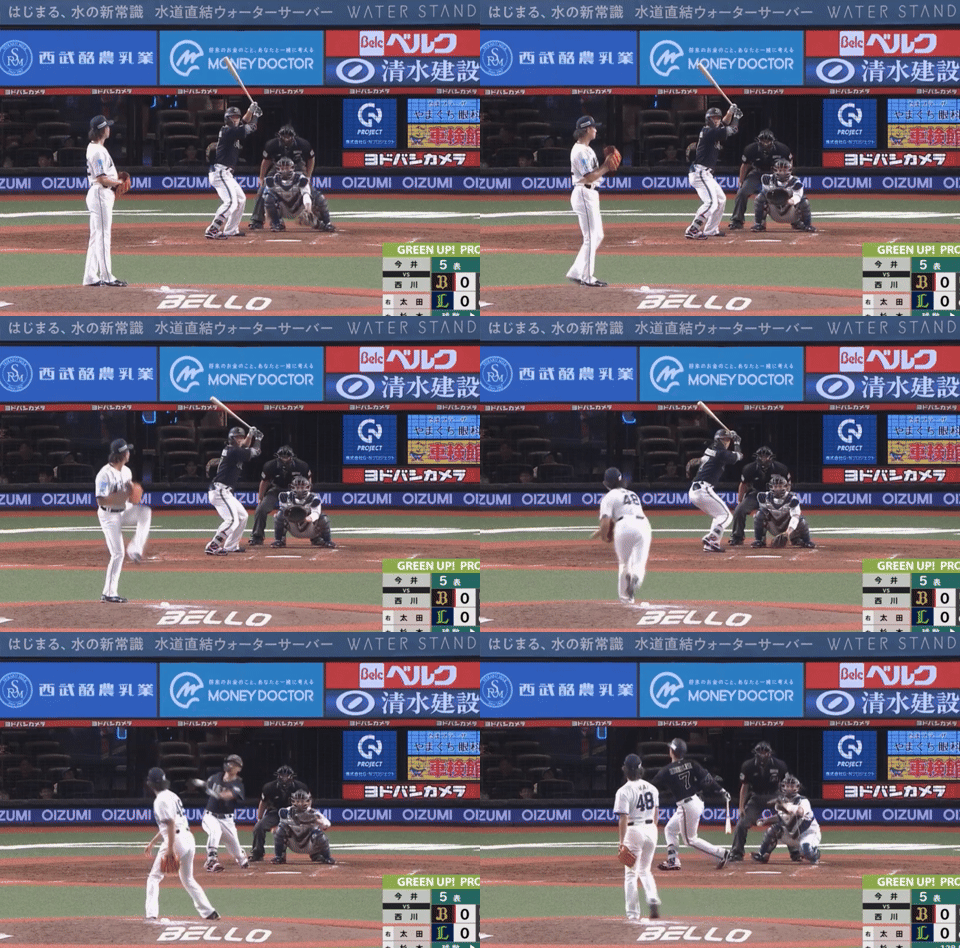
The splitter is less consistent (53% strike rate), but flashes as the better whiff pitch.
Both were effective for him in 2025; of the 460 changeups and splitters I was able to track, Imai registered a 31% zone-whiff rate and 18% swinging strike rate with a batting average allowed of roughly .080 and only one extra base hit.
Imai’s Outlook
One of the more unique arms I have assessed in a while, Imai presents some fascinating questions for teams to answer as the bidding for his services continues up until his January 2 signing deadline.
In speaking to industry sources, there is some skepticism in regards to how the fastball will play, but I lean towards those concerns being overblown.
While there’s hardly any comps for the slider, there are examples of fastballs similar to Imai’s succeeding at similar or lower velocities. An important wrinkle though, is that each of those pitchers (Ryan, Castillo, Ortiz) all mix in sinkers at least 10-15% of the time.
We have a fairly large data set of pitchers coming over from NPB to MLB in recent years, with nearly every arm angle seeing their whiff rate increase by a few percentage points on average, and Imai could skew towards the high end of outcomes given the presumed impending reward for elevating his fastball more.
Even with the career-low walk rate in 2025, I believe the biggest hurdles for Imai will be command and managing lefties. His lower arm angle seems to have created a more natural throw for him, but there will be an added importance on locating his fastball in the upper portion of the zone and the sinker he may add at the lower third of the zone.
Also, with his fastball and slider being less effective against lefties, there’s added importance to locate and execute his changeup and splitter. Imai has the tendency to mix in a fair amount of non-competitive pitches for a pitcher who maintained a walk rate of 7% in 2025, with a huge discrepancy between fastball in-zone rate (62%) and his secondaries (45%).
The slider in-zone rate jumps north of 50% against lefties, giving him a get-ahead pitch there and the fastball dominance against righties should allow him to get away with high usage early in counts, especially if he elevates the four-seamer more with a sinker to complement.
Imai will still be 27 years old at the start of the 2026 season and offers a skill set that I believe gives him a quality starter’s floor with a chance to push towards No. 2 upside.
There may be a bit of an adjustment period to work through as Imai will look to build on a breakthrough year command-wise with a new baseball in a new league, but with my confidence in the fastball and slider translating state-side with potentially even more zone whiff to achieve, should allow him to be effective as soon as he jumps over.
Imai most likely settles in as a strong middle-rotation option with upside for more as he gets his feet wet in the big leagues.
Given his age, positive trend in his walk year, and possibly more to unlock, I think he should be worth more than the six-year, $114 million contract our Editor-in-Chief Ryan Finkelstein projected earlier in the offseason.

Written by
Aram Leighton is the Co-Founder and Executive Editor for Just Baseball. A Syracuse University grad, Aram is one of the hosts of the Just Baseball Show…