
Exclusive: Inside Look At the Defensive Development of Max Clark (Part 1)
Detroit Tigers top prospect Max Clark speaks to his approach in the outfield and how it has helped him improve as a defender.
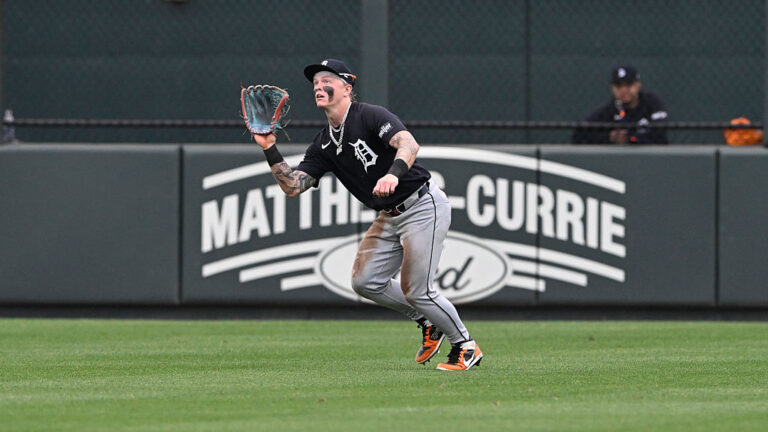
COMSTOCK PARK, Mich. – Max Clark remembers it vividly.
Positioned in center field at LMCU Ballpark, Clark knew Athletics’ High-A infielder T.J. Schofield-Sam was about to cause some trouble.
In fact, it’s what Schofield-Sam had been doing for the better part of the season.
“[Schofield-Sam] had just been murdering the ball,” Clark said. “This is when he was hitting, like, .380. So, I mean, he was just dominating the competition, and he had been hammering balls to right field. I can still remember his shift card is ‘Oppo 4,’ so I was in the opposite gap, and I was like, ‘You know what, I’ve got him pulling the ball.’
“I got him.”
Clark shifted everyone to right-center, positioning himself about eight steps to the left, or the other side of second base. Clark pushed fellow outfielder Seth Stephenson to the line, and as predicted, Schofield-Sam hammered the second pitch he saw.
Clark immediately took off.
“I didn’t think it was going to go, to be honest,” Clark said. “I thought it was going to stay, and it just kept going. It was a beautiful day out, really light air, and it just kept spinning, and he hit it a mile high, so I had tons of time.”
Luckily for Clark, as the ball continued to carry, it began descending right between where the outfield fence padding transitions to chain link, allowing Clark to still have some padding to go up against. Scaling the right-center field wall to pelvis height in an almost Spiderman-like fashion, Clark’s reach came up just short, surrendering a home run.
“I don’t think I’ve ever been closer than that,” Clark said, the adrenaline still audible in his voice. “To be honest, I think if I had gotten to the wall earlier, I might have been able to reach because it was about eight feet over the fence. I think I covered the distance when I got my like pelvis over the wall, but I was out of time, so the ball was already coming down.
“I’ll tell you what, that is absolutely the coolest and most athletic thing I think I’ve ever done in my life,” Clark said. “I had one during my sophomore year in high school, where I actually scaled the wall and caught it, but I’ve never gone over the wall with my body like that.”
Timing
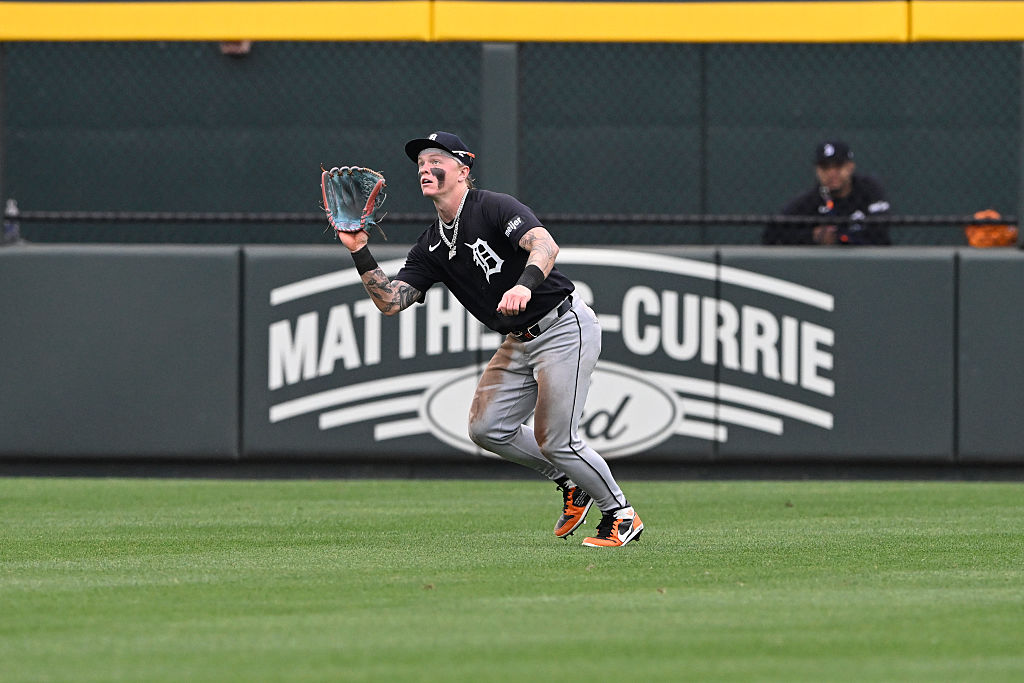
Where misses are often viewed as failure, for Clark, a miss creates an opportunity for growth. In this specific play, Clark knew it came down to timing.
“I think that’s what the missing piece was,” Clark said. “I was literally half a second late in getting to the apex of the wall. I got on the wall at the right time, but I didn’t reach for the ball until it was already coming down. So, then you’re trying to play catch-up, and the ball’s falling like it’s a moving object.
“In high school, I played wide receiver, and they always talk about catching the ball at the highest point because you don’t want to try and catch a ball when it’s coming down,” Clark said.
“This is because you don’t want the defender to be able to jump up and catch it. It’s kind of the same idea. You don’t want to wait for it to come down and then get blocked by the wall at the last second when you try to reach over it. The hardest part about scaling and going up to get things on the wall is the timing aspect.”
Max vs. the Wall
Accessing a reserve of seemingly endless energy, Clark has incorporated wall work into the team’s batting practice sessions. From center field, Clark will work from his left and right sides toward the wall to increase comfort.
“I know it scared the living hell out of [Tony Cappuccilli],” Clark laughed. “I like to practice going up on the wall. It’s way more comfortable when I’m opening to my left, so I have had to work on scaling it with my right shoulder toward the wall. I kind of get stuck when I jump that way versus actually scaling it when I jump to my left. I think the biggest takeaway, honestly, is the timing.
“The biggest balance is knowing if the ball is going to hit the top of the wall, go slightly over the wall, or be, like, right on the wall. It all depends on the size of the fence, too. If it’s a super-tall fence, there’s no point in scaling it, because if it’s over, it’s over. If it’s going to hit the wall, you might as well try to play it off a bounce. But suppose you have walls that have padding and give you the stability to actually climb it. In that case, it becomes about timing, because for me, what I always noticed, especially when I practice it, I’m usually late to go up on the wall.”
Pre-pitch as an Outfielder
While the pre-pitch for an outfielder comes with a lot of variables, Clark has found that pre-stepping like an infielder has worked the best for him.
“I like to take ground balls on the dirt and work on pre-pitch reading swings,” Clark said. “So, any time I can, I try to take infield with the infielders.”
In defensive metrics measurement, Clark has found that teams will generally measure players in three categories: first step, jump and routes.
In Clark’s experience, the first step is the most vital.
“People really underestimate the value of the first three steps,” Clark said. “They underestimate the value of either being down before contact, and then you have to restart your movement or being too late because you would much rather be a hair late than early.
“It’s kind of like stealing bases, especially with the momentum steal,” Clark said. “Like if you’re down early, then you’re stopped, you’re stagnant, and you have to restart. But if you’re down just a hair late, then it’s still okay. Trying to find that middle ground of being in the air when the ball is passing through the contact lane and then being able to land and change position quickly comes from billions and billions of reps and batting practice.”
Reading your Opposition
As the season progresses, on-field batting practice winds down, and players’ legs start to feel heavy, Clark will confine himself to a five-foot circle, shifting his primary focus to physical reads from the hitter and cultivating a better understanding of how the body interacts.
“I’ll just try and get reads before they make contact,” Clark said. “Reading hips, reading hands. It’s kind of the same thing with our position cards. A lot of guys play for the miss, meaning, if a guy strokes the ball in the gap, he earned that one, but more often than not, they’re going to clip it, roll it over, or they’re going to flare it.
“We’re playing basically in a way that would negate their miss, and you’re already working toward that area,” Clark said. “Then you just have that five-foot circle to work with where we’ve got to get out, and we’ve got to go get it out of the circle as fast as we can.”
With the Tigers’ focus on equating pre-pitch work to a tennis player’s positioning to take a serve, Clark’s family connection to tennis has made the equation come together smoothly.
“Fun fact,” Clark said. “I love tennis. My sister was a big tennis player. The way they set up pre-serve and kind of rock into it is exactly the same. I like to get low. I like to feel like I’m being an infielder because I want to be as low to the ground and be able to stay down as long as possible.
“If you watched 100 games of baseball, every single outfielder has a different preset,” Clark said. “We’re not taught one specific way, and it’s kind of like a load sequence. Everybody has their own style, but everybody’s getting down right before contact to be able to move.
“It’s probably just me deep down wishing I was a shortstop.”

Written by