
Breaking Down the Grayson Rodriguez for Taylor Ward Trade
On Tuesday night, the Orioles traded the oft-injured Rodriguez to the Angels for veteran outfielder Ward.
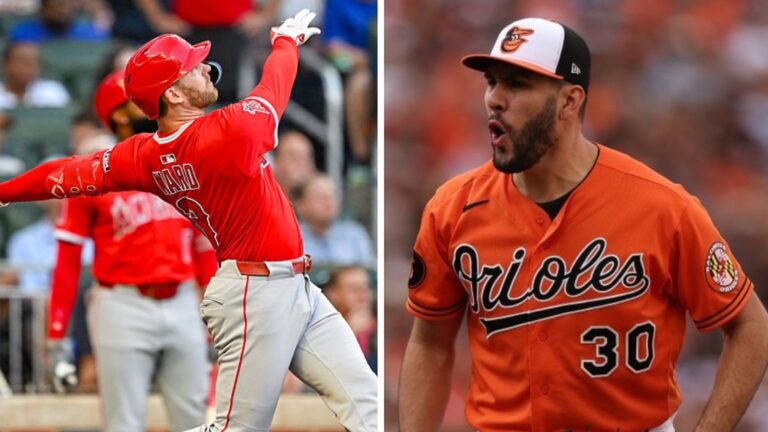
Late Tuesday night, the Baltimore Orioles traded right-handed pitcher Grayson Rodriguez to the Los Angeles Angels.
Rodriguez, 26, missed all of the 2025 season with a lat strain and elbow injury that later caused him to undergo a debridement in August. He last pitched in an MLB game on July 31, 2024.
In return, the Angels sent outfielder Taylor Ward to the Orioles. The 32-year-old is a rental, but one coming off career highs in home runs (36), runs batted in (103), and walk rate (11.3%) in 2025. He also added 2.9 fWAR with a 117 wRC+ in a career-high 157 games.
This trade caught the ire of the public forums when it went down for several reasons. On one hand, it seems like a fleecing by the Angels. After all, they’re trading one year of a passable left fielder with power for four years of someone we’ve seen succeed at the major league level in a starting capacity.
But why did this trade go down? And why did it appeal to the Baltimore front office?
Grayson Rodriguez
The right-hander we remember breaking out in 2024 wasn’t a figment of our imagination, but the injuries are part of the equation. A lat injury shut down a promising 2024. That injury re-aggravated in 2025, and then he later injured his elbow.
According to MASN’s Roch Kubatko on Sept. 29, Rodriguez was slated to ramp up his throwing program in October, thus giving him a somewhat normal offseason of preparation, barring a setback.
Even with that normal progression, that leaves roughly 20 months between regular season starts in MLB. While he’s 26 years old, that time off isn’t insignificant. What we know about the right-hander, at this point, is mostly rooted in belief he’s still the pitcher he was more than a year ago.
Does he come back and immediately average 96-plus mph on his fastball again? Is his improved command going to come back right away? How equipped to provide length will he be?
For his career, he’s got a 4.11 ERA with a 3.80 FIP and an 18.0% strikeout-minus-walk rate in 238.2 innings pitched. He was trending upward when he went down, but that time off bogs down his value immensely.
There’s a reason “all he fetched” was the veteran Ward. What the public perceives as the value of a particular player isn’t always reality; seldom is. This also operates under the assumption that the Orioles were actively looking to move on from the former top prospect, which we don’t know to be true.
For the Angels, adding Rodriguez increases the ceiling of their rotation. Already possessing quality arms Yusei Kikuchi and José Soriano, Rodriguez gives them three pitchers at least to feel good about (assuming health).
Behind Seattle, the American League West is a little leaky. Even without Ward, the Angels are shaping up to pose a threat for second place.
The Orioles Outfield
A common theme of the initial reactions to the trade was Baltimore’s need for starting pitching trumping its need for outfield help. While a team can never have too much pitching, a Ward-less outfield for the Orioles was pretty bleak.
Yes, Dylan Beavers seems like a legitimate everyday contributor and was awesome in 35 big league games last season. But behind him rested Colton Cowser, who regressed heavily in 2025, and Tyler O’Neill, who is oft injured and struggled to produce when healthy in year one for the O’s.
Additionally, only 14 out of 34 right-handed hitting outfielders posted a 110 or better wRC+ with at least 250 plate appearances in 2025.
While Ward isn’t changing many games with his glove, he’s a steadier force with the bat. His career-highs acknowledged, his career averages since breaking out still make for a nice middle-of-the-order bat. Since 2021, Ward has averaged 21 homers and 65 RBI with a 118 wRC+.
Steamer is high on one year of Ward in Baltimore, projecting him for 27 home runs, 87 runs batted in, and 2.5 fWAR in 152 games.
The Orioles’ rotation still has quality at the top, with Kyle Bradish and Trevor Rogers, and depth at the bottom, with Tyler Wells, Dean Kremer, Cade Povich, and Albert Suárez. Could they stand to add someone better as their No. 3 or 4 starter? Absolutely, but that much was true with Rodriguez in their 2026 plans.
Timelines
For the Angels, this is a no-brainer from a timeline standpoint. While Mike Trout isn’t getting any younger, and this trade makes their lineup worse on paper, it affords the Angels a younger and deeper rotation than they had 24 hours ago.
For the Orioles, it looks to narrow a contention window at surface level. While there’s definitely an argument for that, there’s an even stronger argument for this move being necessary.
As things stand, the Orioles don’t have control beyond arbitration on any of their young core besides Samuel Basallo. None of Adley Rutschman, Gunnar Henderson, and Jackson Holliday is locked down on a “second contract.” While none of those three is on the cusp of free agency, capitalizing on as talented a core as that should be Baltimore’s top priority.
Even though Ward is 32, and his contract is expiring, he’s still a good player. He doesn’t chase, finds the barrel, and hits the ball in the air with authority. Not only does he elevate, but he elevates to all fields, specializing in doing so the other way. While playing at Camden Yards in 2025 would’ve hurt his overall power numbers, Statcast still gives him 33 expected for the season.
Baltimore “narrows” its window but does a great service to its lineup in the process. Los Angeles worsens its lineup but dramatically improves the ceiling of its pitching staff. Projecting out, it’s hard to see the Angels not coming out victorious in this deal, but that doesn’t mean the Orioles can’t see a great return on their investment.
There’s a lot of offseason left. Let’s see how Baltimore addresses its rotation before jumping to conclusions on the trade.

Written by