
Tigers’ Max Clark is Using ‘Self-Competition’ to Adjust to Double-A
Detroit Tigers top prospect Max Clark shares his experience adjusting to Double-A, sharing insight on the jump to facing upper minors arms.
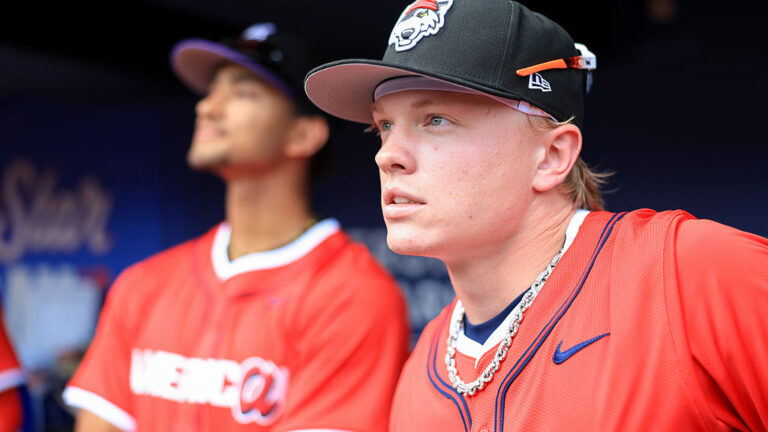
ERIE – If you were to sit and talk with Max Clark for any period of time, you would learn quickly that he’s as eager to talk about failure as he is to talk about success.
For Clark, the two go hand-in-hand. Now nearly 40 games into his Eastern League campaign, the 20-year-old is treating this assignment as he would any assignment.
Observe, analyze, and apply.
Beginning the season with a return to High-A West Michigan, Clark saw a little bit of everything. Three and four-hit games. An eight and a nine-game hit streak. While on the other side of things, there were cold stretches at the plate. In Clark’s mind, it wasn’t a deterrent as much as it was an opportunity to ask the questions of why and analyze how to get over the top of it.
Clark refers to it as “self-competition.” He has never competed with anyone more intently than himself, and navigating the low points of his development track has allowed him to become that much more self-assured in the skill set he believes he’s capable of.
After slashing .285/.430/.427 with an .857 OPS and 21 extra-base hits for the High-A West Michigan Whitecaps, Clark joined teammates Kevin McGonigle and Josue Briceño in a promotion to the Double-A Erie SeaWolves on July 7, in addition to representing Detroit in the MLB Futures game.
Clark is used to a whirlwind. In fact, most of his professional career has been just that, but it hasn’t detoured him from the process of weighing his surroundings and finding a way to excel.
“It’s cool to have a somewhat silencing year where you can start to answer some of the questions that you personally had, like, ‘Am I going to be able to hit for power here? Am I going to be able to do this in the big leagues?” There are questions that I’ve personally answered that are sweet,” Clark said.
“That’s a nice pill to swallow. And then, just being able to go out and compete every day on a Double-A field is great. This is where I wanted to be. It’s the first test, I guess. Obviously, there were tests in High-A, Low-A, and even the FCL.
“Here, you’re playing against guys that are six or seven years older than you, just trying to go out and understand that some of them have been in Double-A for three or four years,” Clark said. “They know how to get outs. They know how to compete. They definitely know how to bully a guy who’s never been in the league. So, just being able to go out and play your game is cool.”
Midwest League vs Eastern League Pitching
As a hitter, it doesn’t take long to notice how Eastern League pitchers operate in comparison to the Midwest League. Following his success with West Michigan, combined with his well-known resume, Clark fully anticipated being studied.
“The biggest difference from the Midwest League is easily the execution,” Clark said.
“You can tell guys do their homework. My scouting report changes day to day. Obviously, I had a good week in Akron, and I come home and I’m immediately getting pitched to differently. They’re trying to find the scouting report. The execution is crazy. There are no more 2-0 cookie heaters. Guys are flipping insiders because they can command pitches whenever they want. The stuff is probably the same, maybe a little bit better. I think it’s the tunneling. The tunneling is better, which makes everything else better. But, from a shape standpoint, they’re the same.”
From what Clark has seen so far, the bullpen is where he’s noticed the biggest jump from his Midwest League assignment.
“The relievers here are way better,” Clark said. “I feel like this is the first level where you want to hammer the starter, but you don’t want to hammer him too badly. You kind of want him in there for five or six innings, because the starters are the 91-95 MPH, three good pitches.
“But then, you get to the pen and everybody’s 98 to 100 MPH with power sinkers or ride cut,” Clark said. “In Akron, everybody was 95-98 MPH with up-shoot. I come home and it’s a bunch of crafty lefties with ride and a guy who’s 95 to 100 MPH with sinkers. It’s just different. You can tell the bullpen usage is different too. Guys are only throwing one inning instead of these long-relief pitchers. Everybody’s going three batters, four batters, and just blowing it up.”
Many players have noted upon arrival to the Eastern League the difference in fastball versus off-speed usage. At the Midwest League level, you find big arms combined with inexperience, and with that comes a lot more fastballs with a desire to flash velocity.
The trouble with this is that the inexperience going hand-in-hand with 100 MPH generally results in not knowing where the ball is going to end up.
By the time these arms reach Double-A, you’re bound to see a far more polished and discerning pitcher who, if they’ve done their homework, will have a pretty good idea of how to work against you at the plate.
“I think they’re using the heaters differently,” Clark said. “I think they’re using heaters in different counts. They’re using heaters when you don’t expect a heater and they’re using breaking balls when you don’t expect a breaking ball. This is the first time in my career that I’ve seen a slider, first pitch of the game. Usually, everybody’s throwing a fastball first pitch of the game. Or if a guy has a cutter, especially. A lot of O-O cutters and they’re top of the first and bottom of the first. They’re just trying to find a way not to give up an easy first pitch hit, or spray a pitch. Guys are coming at you. They can come at you with any pitch and any count.”
This is where the homework comes in.
For Clark, facing Eastern League pitching has required marrying data, IQ, and offensive feel, all while being confident enough to know you may not always make the right decision.
“All these guys usually have four or five pitches,” Clark said. “They’re full arsenal guys, not just one or two good pitches. So, I think for me, I’ve learned to sit on pitches. I’ve never had to, but I’ve always been comfortable with it. Coming up here and being able to execute that is huge. The other night, I faced a lefty, and he had 78% breaking balls. So, I was just sitting breaking balls the whole time. Then, he ended up painting three heaters, and it’s like… It was a good plan, but it was the wrong plan.
“You have to be able to accept that. He made three really good pitches, and then you just try and fight,” Clark said. “If you look at every piece of data, sitting breaking ball was the right choice there, especially with a tough lefty. There were some funny comments made about that, and it’s just outside noise if they don’t really understand what’s actually going on and all the science behind it.”
Staying One Step Ahead
Plate discipline comes naturally to Clark. The 20-year-old is known to spend up to seven days a week in the batting cage during the offseason, and with the investment comes an eye that has grown sharper each season.
Over 68 games with West Michigan, Clark led the league in walks and remains in the top 10 for Midwest League walks nearly 40 games after his promotion to Erie.
In the Eastern League, Clark has already learned that opposing pitchers are not going to issue walks nearly as easily.
“In Grand Rapids, you can go up there twice a game and not bring the bat off your shoulder,” Clark said. “You could probably walk. And here, you have to earn it here. So, I’m swinging way more. I’m more aggressive here. I think I had a…probably, 34% swing percentage in Grand Rapids. I think I’m 44, 45% here. So, 10% more guys are coming at you. Especially early.
“I’ve been swinging early a lot more,” Clark said. “Because you don’t want to get two strikes here. You really don’t want to get two strikes ever, but it was a little more comfortable in High-A. Now, it’s guys with a splitter or whatever, just a ridiculous third pitch for a punch-out. So, it’s harder to draw those, but that’s where the plate discipline comes in.”
Earning walks and the effort it entails in comparison to High-A is hard to miss. With West Michigan, Clark carried a 19.7% walk rate, and since coming to Double-A, that rate has dropped by five percent. But in balancing the plate discipline and staying ahead of his counts, Clark has, in turn, dropped his strikeout rate from 17% to 15.4% and simply put, he’s hitting the ball harder.
Over his first 30+ games with the SeaWolves, Clark has boosted his ISO from .142 to .184, which is above league average.
“I think it’s a mix of both plate discipline and being ahead, for sure,” Clark said.
“But also, sometimes, the first pitch is the best pitch you get. When you break it down and you go from heart (of the zone) pitches, inside the actual heart of the zone, not just in the full strike zone, you want to be swinging at those the highest percentage of the time. Because, in this league, guys are way better at putting things on the edge or in the shadow that make you feel like you have to swing at them.
“But, in reality, it’s way better to be down on the count, 0-1, than to go 0-for-1 at the plate,” Clark said. “Then, also, trying to minimize swinging in the shadow just because it’s hard to lace a ball that’s in the shadow. You can get a couple of hits, but it’s hard to damage those. So, for me, I’m just trying to swing in the heart as much as possible.”
And so, as always, Clark is dug in, and he’s doing exactly what he does any time he’s issued a challenge.
Observe, analyze, and apply.
“It’s tough,” Clark said. “It’s different, for sure. But, at the same time, it’s way better baseball. It’s awesome. The guys have been awesome. And then, obviously, you look at the statistical averages of this league and just trying to beat those and stack up against them. It’s a fun little self-competition, but also just a good place to be.
“And I’m healthy,” Clark said. “That’s the biggest thing.”

Written by